 |
 |
 |
 |
|
History of the Kastom Gaden Association... Page updated |
Kastom Garden Association
|
||||||||||||||||||||||||||||||||||||||||||||||||||||||||
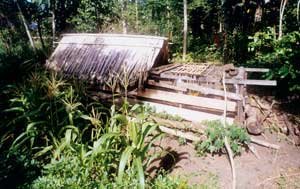
|
The LEISA approach to improved kokorako farming uses: |
|
| • |
local materials for the construction of housing and fencing |
| • |
the hardy local chickens as the basis for cross-breeding with imported varieties to improve productivity |
| • |
local materials for feeding. |
Housing
|
Solomon Island kokorako are usually left to free range through the village. This has a few disadvantages: |
|
| • |
the collection of eggs is difficult; it may be hard to find where the chickens lay |
| • |
the management of the flock is difficult |
| • |
disease is difficult to monitor |
| • | it is not possible to protect the birds from predators |
| • | the flock cannot be improved through cross-breeding. |
To simplify management, the Improved Local Kokorako Farming system houses the chickens in a substantial kokorako house. Depending on the number of chickens kept, the house is divided into rooms into which the chickens can be divided according to age. Feeding takes place in the rooms and age segregation avoids the larger birds out-competing the younger for food.
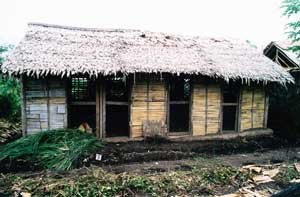
The chicken houses at the Burns Creek centre are made of local materials. The building is divided into three rooms with nesting boxes, feeder and perches. The design was developed by TerraCircle associate, Russell Parker.
|
For reasons of cost and availability, the kokorako house is made of local materials: |
|
| • |
walls are made from the bamboo that grown in the bush |
| • |
the leaf of the sago palm, a traditional buildng material in the Solomons, is used for the roof |
| • |
as a mesh for doors and windows, strips of thin bamboo replace poultry wire, an imported material |
| • | windows are provided for the ventilation to help maintain a healthy environment |
| • | each room has perches adequate for the number of birds, laying boxes (where eggs are laid) and a feeder |
| • | the floor may be made of split bamboo slats or broken coral. |
The kokorako house provides a shady refuge from the hot sun and is predator-proof.
A scratch yard fenced with bamboo, poultry wire, old fishing net or a living fence is provided in front of the kokorako house.
Feeding
|
The same principles used to improve the diet of villagers are applied to kokorako keeping. This classifies feed into three types: |
|
| • |
energy food - carbohydrates such as root crops (cassava, yam, sweet potato) as well as grains like sorghum (all of which can be grown by the kokorako farmer) |
| • |
body building food - protein such as fish meal, grain and greens |
| • |
protective food - vitamins and minerals derived from green and fruiting vegetables. |
At the project centre many of the food types are grown near the chicken house. These include a Japanese green, sorghum, which produces a large seed head and Pigeon Pea (Cajanus cajan), a leguminous shrub that produces pods of black seed. The growing of feed reduces costs and promote self-reliance in inputs.
|
To ensure that the kokorako eat a balanced diet and get enough of each food type: |
|
| • |
feed is presented in a split bamboo container of three compartments into which each food type is placed separately; the kokorako eat as much of each type as they need; the container is equipped with a stand to stop it rolling |
| • |
chickens are separated into age groups so that the older, larger birds do not outcompete the smaller, younger chickens for food; this is done by separating the kokorako into different rooms in the kokorako house; at the project centre the newly-born birds are kept in small, separate houses with the mother chicken until they grow large enough to be placed in the main chicken houses. |
Fresh water is provided every day.
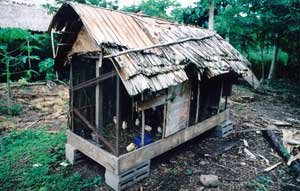
Hens and their young chickens are separated into small houses to ensure they receive sufficient food and water
Management
A daily watering and feeding regime ensures the birds are monitored for disease and egg production.
The rooms are cleaned weekly, the wastes being used as fertiliser on the food gardens.
The project centre has a separate building used as a kokorako hospital. Sick birds are isolated from the flock to prevent the spread of disease. Where available, kastom (traditional) medicines used to treat them.
Breeding
|
The hardy, smaller local varieties are used for breeding with imported varieties. This produces chickens that: |
|
| • |
have the hardiness of the adapted local varieties |
| • |
incorporate the productivity (eggs, meat) of the imported varieties. |
Kept within a managed system, such birds form the basis of a productive flock.
The Burns Creek system
The Improved Local Kokorako Farming system at the Burns Creek project centre is used to trial new ideas and to monitor the performance of the system.
Trainees spending time at the centre get to understand how the system works and to assess its potential for themselves.
>> next project: Integrated Pest Management Project
|
Chicken keeping |
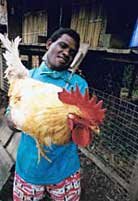
Chicken keeping at the Burns Creek project base used to be a makeshift business.
Now it has been systematised to demonstrate the potential of poultry keeping to improve local diets and earn income.
|
© 2007 Kastom Gaden Association | PO Box 742 Honiara SOLOMON ISLANDS | P: 677 39138 | F: 677 30840 | |